Issue 02 of The Ownership Life
From the Core Declaration to the AND Life
Alyssa Rocco, President, TJT Consulting Life Division · November 12, 2026
The 3 p.m. pickup
A woman wants to grow her business, and she wants to pick her daughter up from school at 3 p.m.
She tells herself, "I cannot do both. If I want to be successful, I have to work longer hours."
Sit with that sentence for a second, because it does not describe a constraint. It describes a conclusion. And the moment she accepts it, she stops looking for anything else.
So let me ask the questions she skipped. What if she stopped scheduling client meetings after 2:30? What if she raised her rates? What if she delegated the administrative work? What if she protected two mornings a week for business development?
I am not promising those four changes solve her week. I am pointing at the question underneath them. What would need to be true for her to grow her business and be the mother she wants to be?
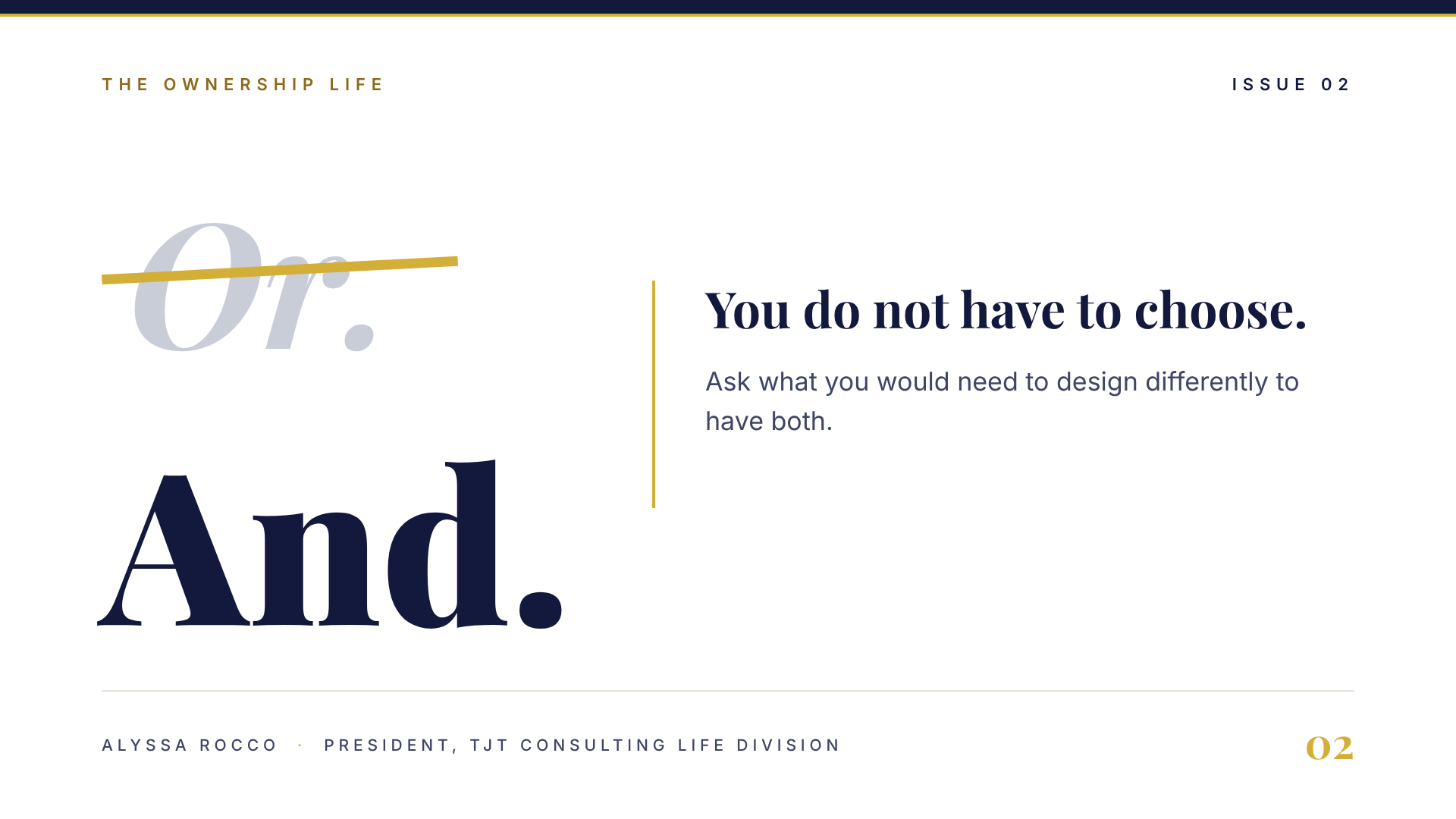
At TJT we call this the AND Life. It is Principle 2 of 10 in the Ownership Operating System, taught together with the T.R.U.S.T. framework and the Four Voices. Instead of asking which one do I have to sacrifice, ownership asks what would I need to design differently to have both.
Why this one comes second
The order matters here, and I do not want you to miss why.
Last week we started with the Core Declaration, the decision that the life you want is yours to take responsibility for. The AND Life only works on top of that decision. If you are still waiting for your circumstances to improve before you move, or still handing your evenings to whoever calls first, you will not redesign anything. You will simply absorb the trade off and call it reality.
Designing a life where two things you love can both exist takes a person who believes the design is theirs to change. That is why the declaration has to come first.
The question I would ask you this week
Here is a question that might completely change how you look at your life. I am giving it to you as the exercise, because it is the one that does the most work with the least effort.
Think about one area where you are unhappy with the result you are getting. Your health. Your marriage. Your money. Your calendar. Pick the one you would rather not pick.
Now ask yourself: if nothing changes over the next three years, am I willing to admit that I allowed it?
Write down the answer. Three years is the right length of time because it is too long to wait out and too short to dismiss. One year feels like a rough patch. Ten years feels like somebody else's life. Three years is close enough to see your own face in it.
That question is confronting, and I want to say again what it is not. It is not a verdict that everything is your fault. It is not a claim that everything is inside your control. It forces us to look past what we want and examine the role we are playing in keeping it out of reach. So the follow on question is the practical one. What am I continuing to accept, avoid, tolerate or leave unchanged that is within my power to influence?
Write that answer down too. In my experience it is rarely a mystery. Most people know the answer before they finish the sentence. What they have not done is look at it in their own handwriting.
Love and independence, not love or independence
Let me give you the version of this that comes up most in people's relationships, because it is the one almost nobody names out loud.
What if you did not have to choose between being in a loving relationship and being fully yourself?
Say you love your partner. But every time you want to spend an evening with friends, or take a weekend for yourself, you feel guilty. So you start saying no to the things you love in order to avoid disappointing them. One no at a time, nothing dramatic. And eventually you feel like you have lost yourself inside the relationship.
Here is the part worth noticing. Nobody in that story made a decision. There was no conversation where you agreed to give those things up. The design simply happened to you while you were being considerate.
So what if the choice is not between love and independence? What if you could have an honest conversation about needing time apart, set a weekly evening that belongs to you, and create space for both of you to have your own lives?
The question is not whether you choose yourself or your relationship. It is how you design a relationship where both can thrive.
That is the AND Life in one sentence. And notice what it costs. It costs a conversation you have been avoiding, not a trade off you have been dreading. Those are very different prices, and we tend to pay the wrong one.
What this is not
I want to be honest about the limits, because I would rather you trust me than feel sold to.
Sometimes a real constraint is a real constraint. Some weeks there is not enough money, not enough help, or not enough hours, and the answer genuinely is that something has to wait. The AND Life does not deny that. What it refuses is the habit of reaching that conclusion first, without ever examining the system producing it.
Before you choose what to give up, question why you believe you have to.
And please do not turn this into one more standard to fail. The goal is not a life where you do everything. It is a life you actually designed, where the things you say matter most have real protection on the calendar rather than good intentions behind them.
So this week, two pieces of paper. On the first, the three year question and your honest answer. On the second, the one conversation you would need to have for both of the things you love to survive the same month.
The conversation is almost always shorter than the years of quietly going without.
Until next Thursday,
Alyssa Rocco
President, TJT Consulting Life Division
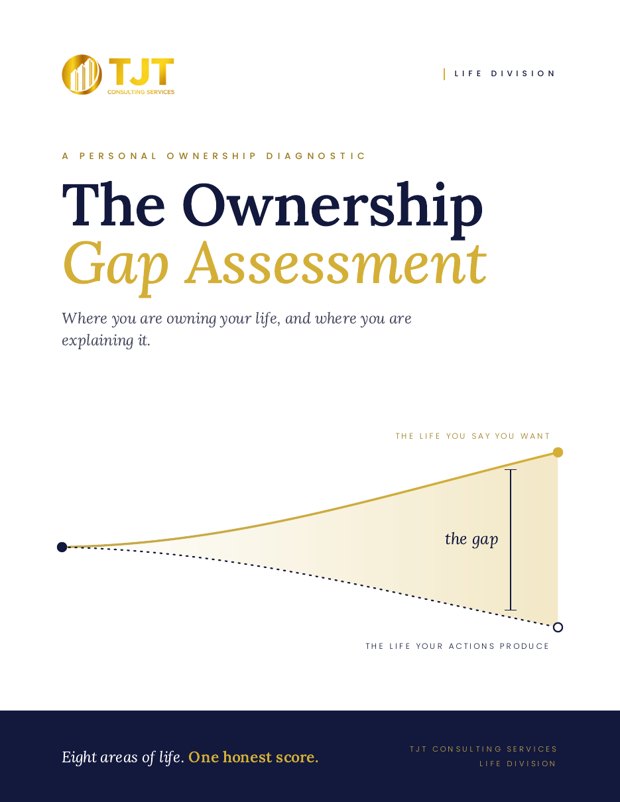
The Ownership Gap Assessment is where TJT Life starts, and it is built to show you the areas where you have accepted a choice you do not actually have to make.
Take the Ownership Gap Assessment